In an era where digital interactions increasingly shape the world, a technology known as deepfakes has emerged, fundamentally shifting the understanding of reality. Deepfakes, a product of advanced artificial intelligence (AI), allow the creation of highly realistic yet entirely fabricated video or audio content. This technology, once exclusive to high-tech labs, is now readily available, making it a matter of concern in today’s digitally dominant world. This article aims to unfold the deepfakes phenomenon, tracing its journey from a promising novelty to a potentially harmful tool. As you progress, you’ll delve into the technology behind deep fakes, its evolution, its uses, and its dark side.
Understanding AI And Deepfakes
In its simplest form, Artificial Intelligence (AI) is the simulation of human intelligence processes by machines, especially computer systems. It involves learning, reasoning, and self-correction. Deepfakes, on the other hand, represent a specific application of AI, utilizing a type of algorithm called Generative Adversarial Networks (GANs). Deepfakes are synthetic media in which a person’s likeness is swapped with another’s, creating convincing false images and videos.
The key technology driving deepfakes is machine learning, a subset of AI wherein a model is trained to make predictions or decisions without being explicitly programmed. This, combined with GANs, leads to the creation of realistic imitations. Deepfakes function by training two competing neural networks to create false videos (the ‘generator’) and the other to detect the falsifications (the ‘discriminator’). This continual competition improves the sophistication of the fakes, resulting in increasingly realistic deep fakes.
The Evolution Of Deepfakes
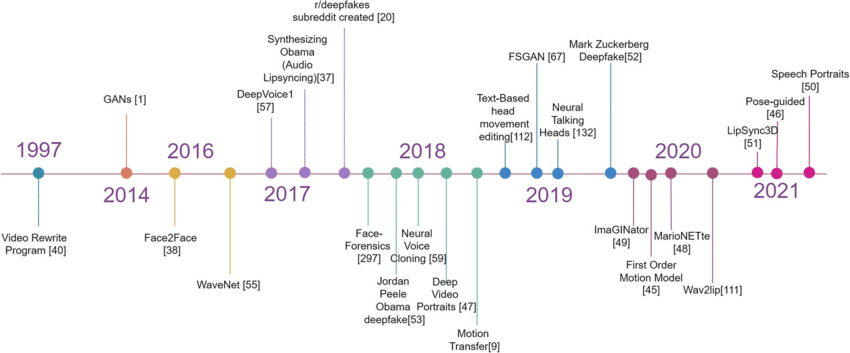
Deepfakes weren’t born overnight. They are the result of years of progress in the realm of AI. Their evolution can be traced back to the dawn of machine learning and computer vision technologies. The early instances of deepfakes were fairly detectable, as the technology was still in its infancy. However, as AI algorithms grew more sophisticated, so did the realism of deepfakes.
The swift advancements in technology have led to an alarming increase in the quality of deepfakes. Today, deepfakes are almost indistinguishable from reality, given the right amount of data and processing power. This progression has expanded the use cases for deepfakes, opening doors to potential misuse and making it essential to understand their applications and implications.
Deepfakes In Social Media And Entertainment
Deepfakes have found their place in various corners of society, particularly in social media and entertainment. They’ve been used to generate content ranging from humorous memes to sophisticated film visual effects. For example, many popular movies now use deepfake technology to de-age actors or to recreate performances of actors who have passed away.
While technology presents exciting possibilities in entertainment and media, it’s not without its challenges. Issues surrounding consent and manipulation have arisen, stirring debates about the ethical implications of deepfakes. Despite these concerns, the technology’s potential to revolutionize content creation cannot be denied. However, as deepfakes continue to blur the line between reality and fiction, it becomes more urgent to navigate the ethical boundaries of this technology.